
Feeling Better vs. Getting Better
The difference between wellness and recovery — and why it matters
Key Takeaways
- Wellness focuses on feeling better. Recovery focuses on getting better. The difference is clinical, not semantic.
- Wellness practices can help, but only when integrated consistently into daily life.
- Spiritual bypassing — using wellness or spirituality to avoid deeper psychological work — is common in addiction and mental health.
- Lasting change requires consistency, values alignment and honest self-assessment. Occasional wellbeing experiences rarely produce it.
The wellness industry offers cold plunges, breathwork, adaptogens, sound baths and spiritual retreats. Some of it is genuinely useful. Some of it is an expensive ritual dressed up as transformation. The difference matters enormously — particularly for people in addiction recovery or serious mental health treatment.
Wellness asks: how do I feel right now? Recovery asks: who am I becoming?
The difference between Wellness Vs Recovery
Wellness is about optimisation. About feeling good, managing stress, cultivating vitality. Recovery is about identifying the patterns, behaviours and neurological states that are causing harm, and systematically rebuilding them. A wellness experience can be passive. You can receive it, enjoy it and return to your life unchanged. Recovery cannot be passive. It requires confrontation, consistency and a willingness to be uncomfortable long after the pleasant experience has ended.
Wellness is a temporary elevation of your current state. Recovery is a permanent change to your baseline.
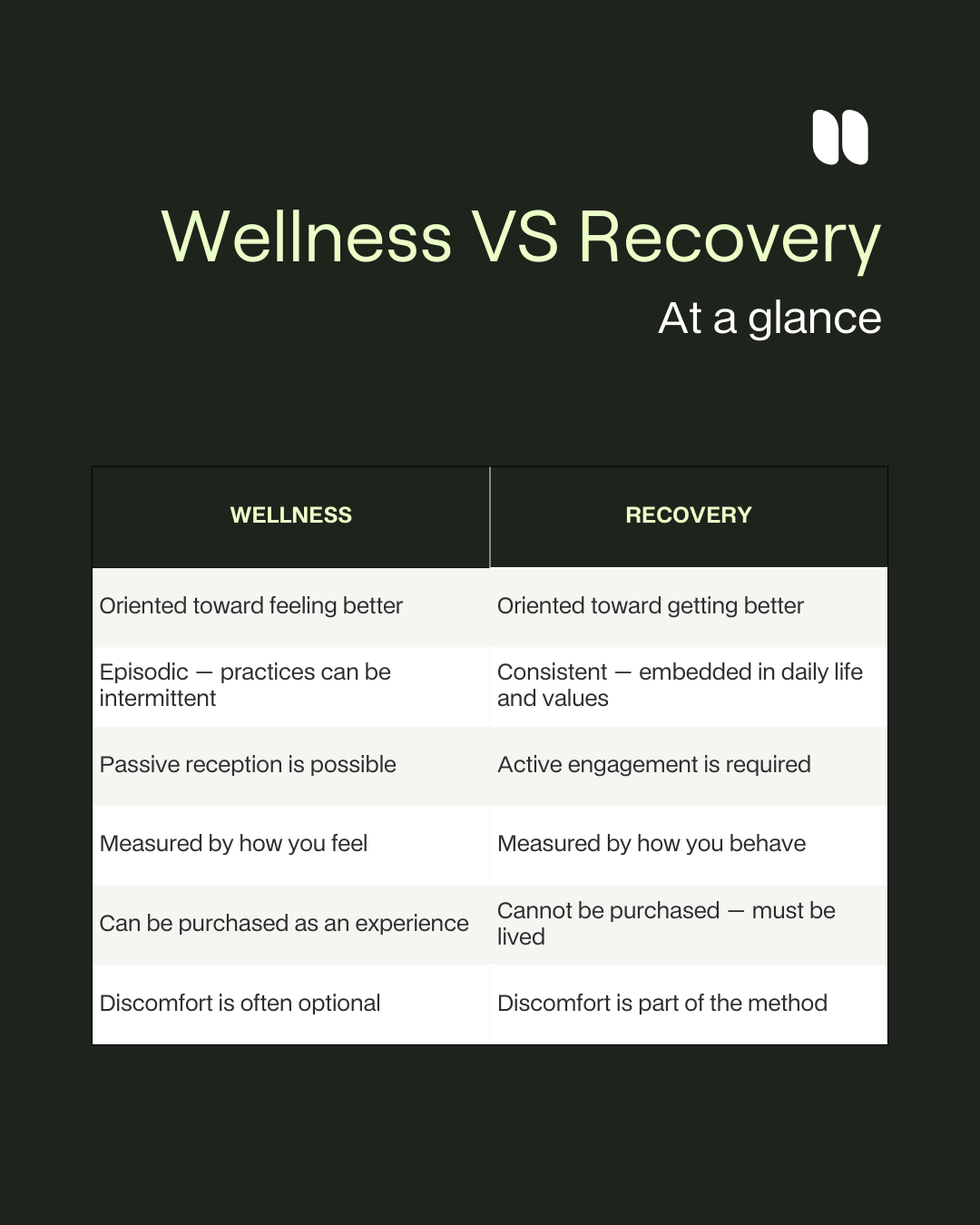
When "Wellness" becomes a problem
The problem is not the practices themselves — ice baths, breathwork, meditation and sauna have genuine physiological effects. The problem arises when they are used as a substitute for harder work, or when their language provides a sense of progress without the substance of it. Psychologist John Welwood called this spiritual bypassing: using wellness or spiritual frameworks to sidestep genuine psychological work. The person who returns from a five-day retreat glowing — and is back in the same patterns within a fortnight. Or the person who replaces a harmful dependency with a wellness dependency, substituting one neurochemical hit for another without ever addressing the underlying dysregulation. The vehicle changes. The driver does not.
How to Tell if Your Practices Are Creating Real Change
Wellness practices can support recovery, but the distinction is whether they actually change behaviour outside the practice itself. An ice bath, meditation, or retreat may feel beneficial in the moment, but recovery begins when those practices build the capacity to regulate under real pressure — in conflict, stress, or craving. The real test is transfer: if patterns, reactions, and relationships begin to shift over time, the work is moving from feeling better to actually getting better.
You cannot retreat your way to recovery. You can only practise your way there — one ordinary day at a time.
Feeling better is the beginning. Getting better is the work.
--------------------------------